Bookkeeping for self-published authors, sorted by Schedule C line
If you sell books on Amazon KDP, IngramSpark or anywhere else in the US, the IRS treats it as a business, and your income and costs go on Schedule C. Tax time is a lot easier if every cost is already tagged with its Schedule C line when you write it down.
This is how to set that up in Google Sheets. It isn't tax advice, so check anything you're unsure about with your tax preparer.
Log income one payment at a time
Make an Income tab with one row per payment:
- Date paid
- Source (KDP, IngramSpark, Draft2Digital, an event, a speaking fee)
- Book
- Format (ebook, paperback, hardcover, audiobook)
- Units sold
- Amount
Royalties all go on line 1 of Schedule C as gross receipts. Logging them by source still matters, because platforms like KDP send a 1099, and you'll want to check your total against theirs.
Tag each expense with its line
Make an Expenses tab with date, what it was, amount, category and Schedule C line. Then make a small Lists tab that pairs each category with its line, and look the line up instead of typing it each time:
- Amazon or Facebook ads: line 8, advertising
- Freelance editor or cover designer: line 11, contract labor
- Accountant or a lawyer for contracts: line 17, legal and professional services
- Software, website hosting and office supplies: line 18, office expense
- ISBNs, contest fees and memberships: line 27a, other expenses
With the Lists tab in columns A and B, the line for a category in D2 is =VLOOKUP(D2,Lists!A:B,2,FALSE).
Total each line
On a Taxes tab, list each Schedule C line once and add up what belongs to it:
=SUMIFS(Expenses!C:C,Expenses!E:E,A2,Expenses!A:A,">="&DATE(2027,1,1),Expenses!A:A,"<"&DATE(2028,1,1))
Change the year in both DATE parts to see any other year.
Track miles too
Drives to signings, bookstores and the post office count. Keep the date, where you went, why, and the miles. Multiply the total by the IRS standard mileage rate for that year, which goes on line 9.
If you'd rather not build it
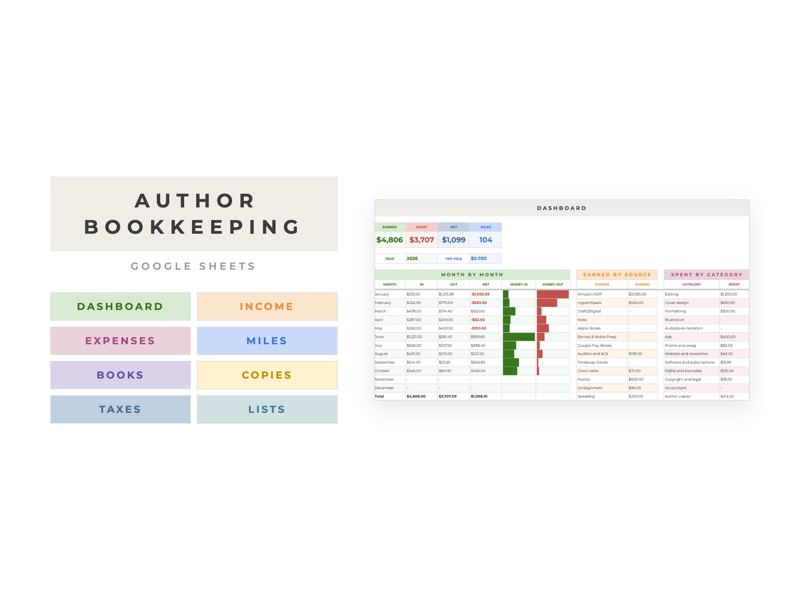
Author Bookkeeping has all of this set up: 28 author expense categories already tied to their Schedule C lines, income sources like KDP and IngramSpark, a mileage log, totals for each book, and a check that shows where a platform's 1099 and your records don't match.